CAMHLAB artists honor and support Freedmen’s Town through projects this summer

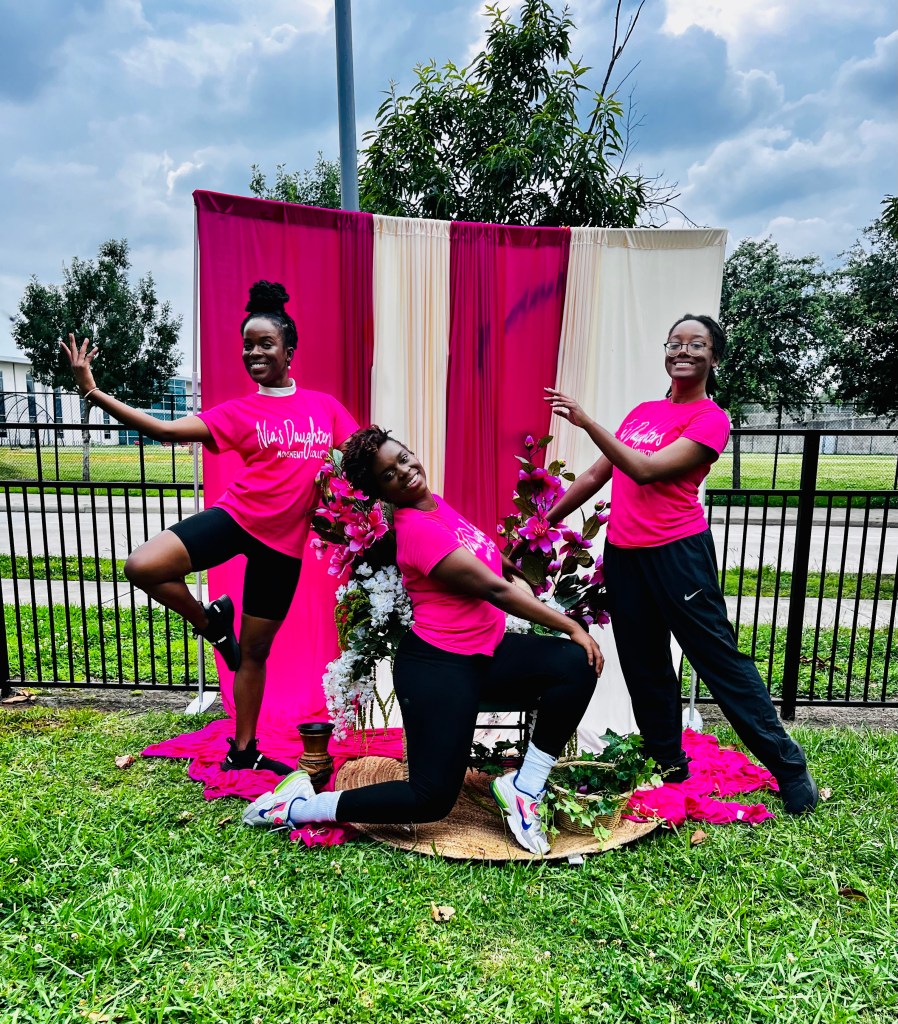
Nia’s Daughters Movement Collective hosted a Mother’s Day event with storytelling and a movement class in Wiley Park in Freedmen’s Town, May 2023 / Photo courtesy of Stacey Allen

A partnership of Houston Freedmen’s Town Conservancy and Contemporary Arts Museum Houston, CAMHLAB at Freedmen’s Town is a new site-specific iteration of the museum’s CAMHLAB artist residency program—an initiative that grew out of the pandemic, which has previously utilized spaces like CAMH’s Brown Foundation Gallery and Montrose Collective.

Through residencies by four artists and collectives between June – September 2023, CAMHLAB at Freedmen’s Town aims to honor, preserve, and amplify the histories, stories, and experiences of Houston’s oldest Black settlement and its residents.

Situated along Buffalo Bayou in Houston’s Fourth Ward, Freedmen’s Town was settled shortly after June 19, 1865—Juneteenth—when enslaved African Americans were finally granted the freedom that had been legally theirs since the issuance of the Emancipation Proclamation 2 ½ years earlier. Eager to begin new lives in a new place as freed people, these men, women, and children from the surrounding rural areas journeyed to Houston, and began creating a community.

In what became known as Freedmen’s Town, they built homes, schools, businesses, churches, and lives. They built a world in which African Americans could prosper and thrive. Freedmen’s Town is where Black Houston took shape … By 1880, Freedmen’s Town was home to 95% of Black Houstonians. By the 1930s, it had produced over 400 Black-owned businesses. It was the “mother ward,” the Harlem of the South.

Houston Freedmen’s Town Conservancy
Freedmen’s Town overlooking downtown Houston / Photo courtesy of Houston Freedmen’s Town Conservancy

In March, the mental health and arts nonprofit The Black Man Project, dance company Nia’s Daughters, and interdisciplinary artists Ann ‘Sole Sister’ Johnson and Billion Tekleab were announced as the 2023 CAMHLAB Freedmen’s Town Artists-in-Residence, and they will carry out projects, community activities, and public presentations over the course of this summer and coming months.

Choreographer and dancer Stacey Allen is the founder and Creative Director of Nia’s Daughters, a movement collective whose works aim to incorporate social justice and activism. During their residency, Allen says her company will create a body of work that centers the stories of resilience and resistance of African Americans in Texas—including The Fairytale Project, a dance theater production inspired by the love story of Jim and Winnie Shankle, and Aesthetic Inheritances, a film and exhibit made in collaboration with artists Danielle Mason and Keda Sharber, which highlights the Freedom Colony Barrett Station and explores Black material culture.
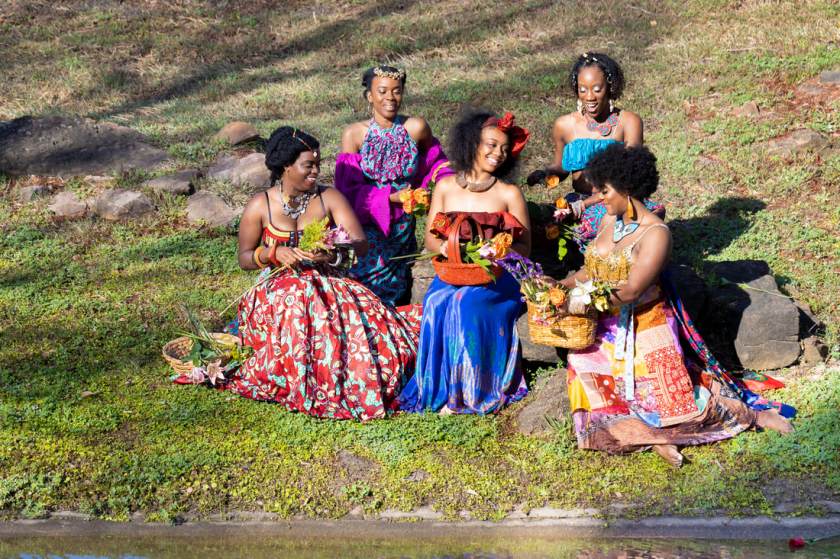
Nia’s Daughters in “The Fairytale Project” / Keda Sharber of Images by Papillon

“This work in Freedmen’s Town is a beautiful extension of this path of storytelling. We’ve been here and will not allow for our stories to be erased. Our goal is that this work conjures memory and sparks something inside audiences, and they cherish their own histories,” said Allen.

According to Allen, Nia’s Daughters kicked off their CAMHLAB residency by hosting an interactive, yet laidback outdoor Mother’s Day event in May in Freedmen’s Town.

“We engaged residents with storytelling with the elder Sister Mama Sonya, and our company members, Lakendra Howard and Sydney Hart with myself led the children in a movement class,” said Allen. “The rest was a super organic kickback—popcorn, juice, a DJ—you know, feeling the flow of Sundays at Wiley Park.”
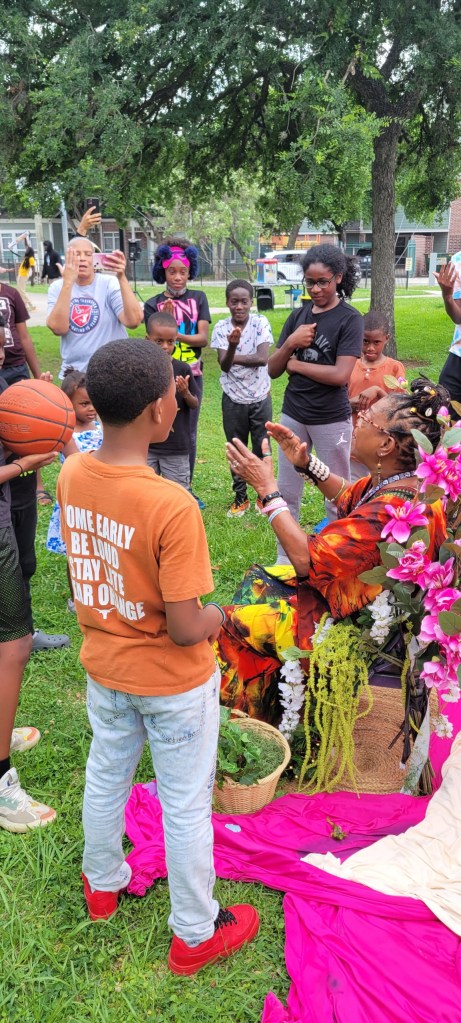
Nia’s Daughters presented a Mother’s Day event at Wiley Park to kick off their CAMHLAB at Freedmen’s Town artist residency / Photo courtesy of Stacey Allen

Allen says they will return to Wiley Park for another event in coming months, which will include more movement classes, more storytelling, and more kicking back with the community.

“We truly respect the work that Charonda Johnson [Vice President of the Freedmen’s Town Association and a fifth generation Freedmen’s Town resident] has done in her neighborhood and are just honored to be able to build trust with Freedmen’s Town residents and share our movement practice with the youth.”

Allen told Houston Arts Journal that Nia’s Daughters will also present a public program at POST, to be scheduled in the fall, which will include a quilting workshop by Joethella Gipson and the debut of Sister Mama Sonya’s “mahogany messages: poetic melodies,” a new poetry and dance piece with narratives about Freedmen’s Town residents.

This work in Freedmen’s Town is a beautiful extension of this path of storytelling. We’ve been here and will not allow for our stories to be erased. Our goal is that this work conjures memory and sparks something inside audiences, and they cherish their own histories.

Stacey Allen, Nia’s Daughters Movement Collective

These artist residencies point to a community partnership between Contemporary Arts Museum Houston and Houston Freedmen’s Town Conservancy that goes back to 2020, when the two organizations began formal discussions and programming centered around community engagement and empowerment, as well as “the shared belief that arts and culture is an essential catalyst for change.”

Their partnership also supports artists-in-residence at POST, including Freedmen’s Town Lead Research Fellow Amarie Gipson, whose Reading Room is a curated library of books by and about Black artists, and Freedmen’s Town Film Documentarian Nate Edwards, whose works-in-progress can be viewed this summer during open studio hours:

CAMHLAB at Freedmen’s Town is part of Rebirth in Action: Telling the Story of Freedom—a multi-year project of CAMH, HFTC, the City of Houston, and artist Theaster Gates—which was announced in January and funded by a $1.25 million grant from the Andrew W. Mellon Foundation and an NEA “Our Town” grant.

With the goal to “to promote Houston Freedmen’s Town as monument of Black community, agency, and heritage,” according to a press release, Rebirth in Action includes various phases of artist-led, community, and infrastructure projects—including the archaeological preservation of brick streets, laid by formerly enslaved residents, which hold historical, spiritual, and cultural significance.

Historic Freedmen’s Town bricks at the intersection of Wilson Street and Andrews Street / Photo courtesy of Contemporary Arts Museum Houston

Here’s what happened at the Houston Mayoral Forum on Arts and Culture

L-R: Linda Lorelle, moderator, with Houston mayoral candidates Robin Williams, John Whitmire, Sheila Jackson Lee, Lee Kaplan, Gilbert Garcia, Robert Gallegos, and Amanda Edwards at the Houston Mayoral Forum on Arts and Culture / Photo by Catherine Lu

This past Monday night, the Houston Mayoral Forum on Arts and Culture—the first candidate forum of this campaign—took place before a packed audience at the Hobby Center’s Zilkha Hall.

The public event was organized by the city’s seven state-designated cultural districts: Arts District Houston, East End Houston Cultural District, 5th Ward Cultural Arts District, Houston Museum District, Midtown Cultural Arts and Entertainment District, Third Ward Cultural Arts District, and Theater District Houston.

In an interview with Houston Public Media, Alison Weaver, Co-President of the Museum District Association and Director of Rice University’s Moody Center for the Arts, said it was exciting to see Houstonians’ enthusiasm and support for the city’s arts and culture.

“We had over 600 people registered for the event before we had to shut down the online registration system,” said Weaver on Houston Matters with Craig Cohen. “So, the energy in the room was fantastic. The interest from across the city was extraordinary.”

According to Hillary J. Hart, Chair of Theater District Houston and Executive Director of Theatre Under the Stars, 400 people showed up in person for the event, filling Zilkha Hall to near capacity.

One of those in attendance was writer, activist, and Houston Poet Laureate, Aris Kian Brown, who live tweeted the forum from her perspective as a member of the arts and culture community:

Brown documented the candidates’ responses—including goals to increase public art, create affordable housing for artists, and identify new sources of funding for artists—while also expressing her frustration for what she called a lack of “innovative solutions.”

“The candidates had no genuine solution or long-term engagement with arts institutions or artists. We have so much work to do,” she tweeted.

Seven Houston mayoral candidates participated: Amanda Edwards, Robert Gallegos, Gilbert Garcia, Lee Kaplan, Sheila Jackson Lee, John Whitmire, and Robin Williams.

Emmy Award-winning journalist Linda Lorelle served as moderator. Lorelle is also a ballroom dancer, who has been involved on the advisory board for Hope Stone Dance.

Lorelle told the audience that all of the questions were “sourced after conversations and interaction with all of you in the community. So, these are the questions you want answered.”

Candidates responded in alphabetical order, with two minutes to answer each question.

You can watch the entire 2023 Houston Mayoral Forum on Arts and Culture, recorded by Houston Media Source, here:

Forum Questions:

  1. “More than 70% of Americans believe that the benefits of the arts extend beyond the individual to the community. If you are mayor and are planning for the city of the future, how will you ensure that Houston is recognized as a cultural leader?” [14:00 mark in the video]
  2. “Dallas spends on average $17 per capita on the arts, while Austin spends $22.90, compared to Houston’s—are you ready for it—$6.70 … Houston’s thriving arts and culture scene is a significant contributor to the quality of life for its residents and visitors. It is an important economic driver, a primary recruiting tool for corporations, and a key tourism attraction for the city. So, in addition to the current Hotel Occupancy Tax allocations, what plans do you have as Mayor to increase funding for the arts outside of the Hotel Occupancy Tax?” [27:05 mark in the video]
  3. “The city’s previous Cultural Plan is dated 2015. What is your plan as Mayor to invest in and commit to a new citywide Cultural Plan for 2024 and beyond? How will you ensure that diversity, equity, and inclusion are prioritized under this plan?” [42:30 mark in the video]
  4. “There is near universal support for arts education: 91% of Americans believe that the arts are part of a well-rounded K-12 education. Over 90% say students should receive an education in the arts in elementary, middle, and high school. With the state taking over HISD, how will you as Mayor assist schools in making arts education a priority and accessible?” [57:16 mark in the video]
  5. “The arts sector needs artists and workers to thrive. How would you as Mayor ensure that Houston’s diverse artists and cultural workers stay here and thrive here?” [1:12:23 mark in the video]

You can also read the candidates’ written responses to a Pre-Forum Q&A here.

Houston mayoral candidates will discuss the role of arts and culture in the city’s future

Mural in progress by artist Aches, located on the side of Houston Ballet’s Margaret Alkek Williams Center for Dance, and “Imagine,” an art car by artist Ruth Sosa Bailey / Photo by Elizabeth Sosa Bailey

The public will have the opportunity to ask Houston mayoral candidates about their visions, stances, and plans for arts and culture in the city, if elected, at a community forum. The Houston Mayoral Forum on Arts and Culture will take place on Monday, June 12, 2023 at 6:30pm, preceded by a public reception at 5:30pm, at the Hobby Center’s Zilkha Hall.

The forum is organized by the city’s seven state-designated cultural districtsArts District Houston, East End Houston Cultural District, 5th Ward Cultural Arts District, Houston Museum District, Midtown Cultural Arts and Entertainment District, Third Ward Cultural Arts District, and Theater District Houston. The event is free with an RSVP.

According to a press release, organizers aim to bring the arts sector together to learn about candidate policy positions related artists, arts educators and administrators, culture bearers, and cultural institutions—and to seek answers to the question, “As Houston continues to grow, what role will arts and culture play in this ever-changing environment?”

“The arts sector is still recovering from significant events such as the pandemic,” said Harrison Guy, Artistic Director of Urban Souls Dance Company and Director of Arts and Culture of 5th Ward Cultural Arts District, in a statement.

“As we gear up for an essential election in our city, it’s crucial to create a space for a much-needed conversation that not only focuses on the arts but also acknowledges that artists are small business owners. We must also recognize that arts organizations are a driving force behind what makes our city thrive,” he said.

Based on the Arts and Economic Prosperity 5 report, the most recent national economic impact study by Americans for the Arts, the Greater Houston Region generated $119.3 million in local and state government revenues and supported 25,817 full-time equivalent jobs in 2015. Total spending in the arts and culture industry for the area (including spending by organizations and audiences) was $1.1 billion, helping to generate $801.6 million in household income for local residents.

“As critical economic drivers and significant contributors to the development of our communities, arts and culture must be part of the conversation regarding Houston’s future,” said Hillary J. Hart, Executive Director at Theatre Under the Stars and Chair of Theater District Houston, in a statement.

The format of the Houston Mayoral Forum on Arts and Culture will include opening statements by each candidate, followed by questions from Emmy Award-winning journalist Linda Lorelle, who will serve as the moderator, and questions from the audience. The public can submit questions in advance online, as well as at the event in person.

Writer, educator, and activist Tony Diaz says that he plans to attend the forum to voice his concerns for the evolving needs and changes of the local cultural landscape.

“This is a very exciting time for Latino art and culture in Houston with ALMAAHH about to hire a full-time president of the organization as it launches its visioning sessions quantifying Houston’s Latino Art Eco System, which will be part of its 2023 report. BANF is also identifying and supporting Latino individual artists, collectives, and nonprofits,” Diaz told Houston Arts Journal.

“As an artist, and as the founder of Nuestra Palabra, I would like to know how the mayoral candidates propose to create more funding for Latino Arts nonprofits, collectives, and individual artists. Also, how will they devise ways to work with, build on, and institutionalize the findings of ALMAAHH and BANF to raise Houston’s profile as a Latino arts city?” he said.

Organizers say that all Houston mayoral candidates have been invited to participate in the forum. Confirmed attendees at the time of this publication include Amanda Edwards, Robert Gallegos, Gilbert Garcia, Lee Kaplan, Sheila Jackson Lee, and John Whitmire.

Election Day is Tuesday, November 7, 2023. Incumbent Mayor Sylvester Turner, who has been recognized for his support of arts and culture, is term-limited and will leave office in January 2024.

The public can check voter registration status here and register to vote here.

A Mayoral Forum on Arts and Culture was also held prior to the 2015 Houston Mayoral election.

Arte Público receives $500,000 NEH grant toward preserving and digitizing U.S. Hispanic literature

Gabriela Baeza Ventura, executive editor of Arte Público Press and co-founder of the U.S. Latino Digital Humanities program at University of Houston / Photo credit: University of Houston

The National Endowment for the Humanities recently awarded Arte Público Press a major $500,000 challenge grant in support of its Recovering the U.S. Hispanic Literary Heritage Program.

Launched in 1992, Arte Público’s Recovery Program is considered the first nationally coordinated attempt—and the largest endeavor of its kind—to recover, index, and publish lost Latino writings that date from the American colonial period through 1960, as described on its website. Its ongoing efforts include the collection and digitization of books, manuscripts, newspapers, photographs, correspondence, and other archival items, including diaries, oral lore, and popular culture.

The grant comes as the NEH recently announced $35.63 million in funding for 258 humanities projects nationwide in various grant categories. Of the 13 Texas institutions and individuals funded during this grants cycle, Arte Público received the largest amount in the form of an NEH Infrastructure and Capacity Building Challenge Grant.

As a challenge grant, the $500,000 from the NEH aims to leverage federal funding to spur nonfederal support—requiring it to be matched 1-to-1, with Arte Público to fundraise another $500,000 over the next three years. Together, the $1 million will be used toward two main goals, according to a press release: “1) organize, index and preserve digital content and 2) provide multilevel access to the documents and metadata for a wide range of audiences in the United States and abroad.”

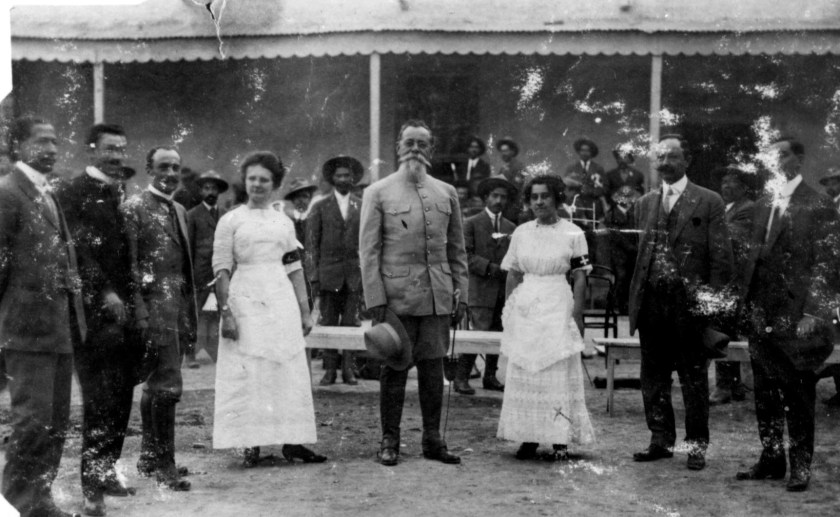
Leonor Villegas de Magnón, Venustiano Carranza, Lily Long and Others,” Recovering the US Hispanic Literary Heritage Digital Collections / Courtesy of Arte Público Press

Arte Público says that the Recovery Program’s documents are currently stored in several different servers and are not easily searchable. That will change with the implementation of the NEH grant.

“This support from the NEH will be critical in generating additional funding to create a customized cloud-based digital repository of texts and content management system, all with the long-term goal of making the hundreds of thousands of Latino texts already preserved by the Recovery Program accessible to scholars and community members,” said Dr. Gabriela Baeza Ventura, Executive Editor of Arte Público, in a statement.

Baeza Ventura is also Co-Director of the U.S. Latino Digital Humanities Center, which serves as a venue for the Recovery Program’s archives and whose digital infrastructure will be improved through the NEH grant.

At a time when PEN America reports that book bans are on the rise, increasing by 28% during July to December 2022 when compared to the previous six months—with 30% of banned titles being books about race or racism, or that feature characters of color—there is vocal concern for barriers to access to works by Latino authors, particularly in Texas which leads the nation in book bans.

“This grant is extremely significant not only because it will aid the program to consolidate its archive amassed through more than 30 years of research, but also because it will provide a venue to access materials pertinent to U.S. Latino history and literature that is not accessible and increasingly in peril of being lost or banned,” said Baeza Ventura in an email to Houston Arts Journal.

Founded in 1979 by Dr. Nicolás Kanellos, Arte Público is recognized as the nation’s oldest and largest publisher of contemporary and recovered literature by U.S. Latinx authors. It has published bestselling authors, such as Nicholas Mohr, Victor Villaseñor, and Helena María Viramontes, as well as seminal works, including Sandra Cisneros’ The House on Mango Street.

Discovery Green announces a new President to lead the management, growth of the downtown park

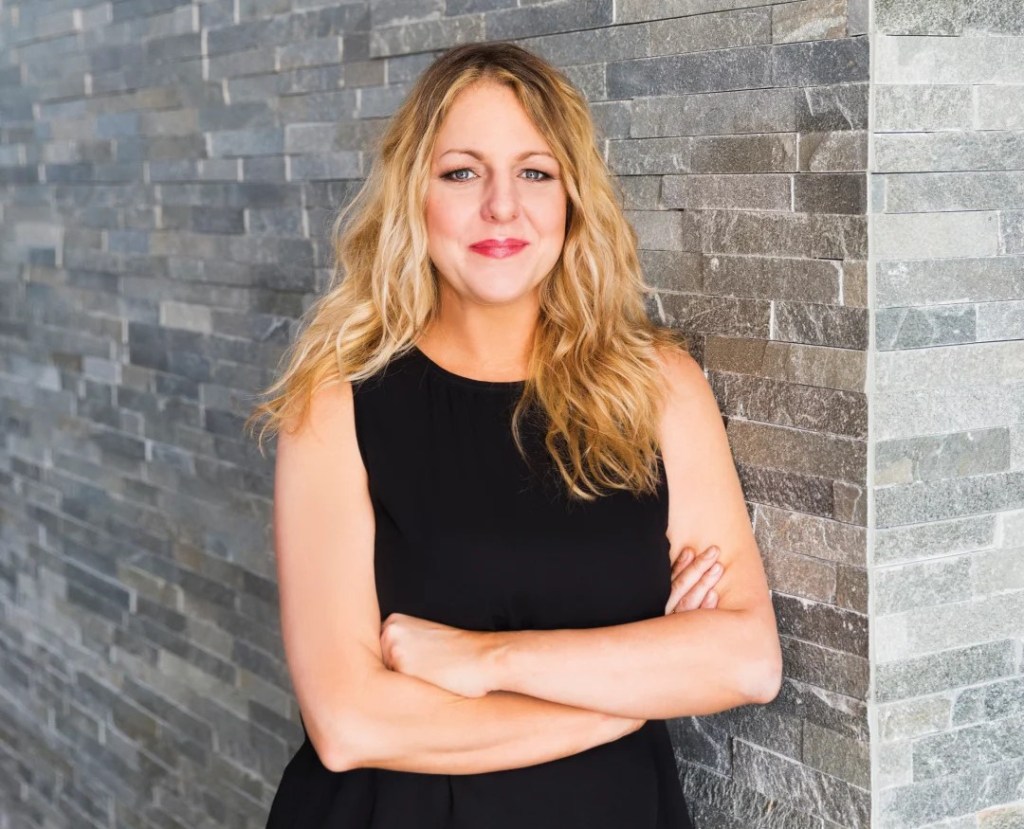
Kathyrn Lott / Photo by Julie Soefer

Twenty-year veteran of the nonprofit and arts world, Kathryn Lott has been named President of the Discovery Green Conservancy, the nonprofit that runs the 12-acre downtown park through a public-private partnership with the City of Houston.

Lott will begin her leadership role on July 1, 2023, succeeding longtime President Barry Mandel who is retiring after serving as President since 2010.

Since its opening 2008, Discovery Green Park has welcomed more than 20 million visitors, according to its website. Located across from the George R. Brown Convention Center, the urban green space includes a one-acre lake, fountain, playground, public art installations, gardens, and on-site restaurants. The Discovery Green Conservancy works with hundreds of community partners to program family-friendly, arts and culture, and wellness events annually, most of which are free to the public.

As President, Lott will spearhead efforts behind the care, maintenance, and programming of the park, as well as raising more than $6 million toward its annual budget.

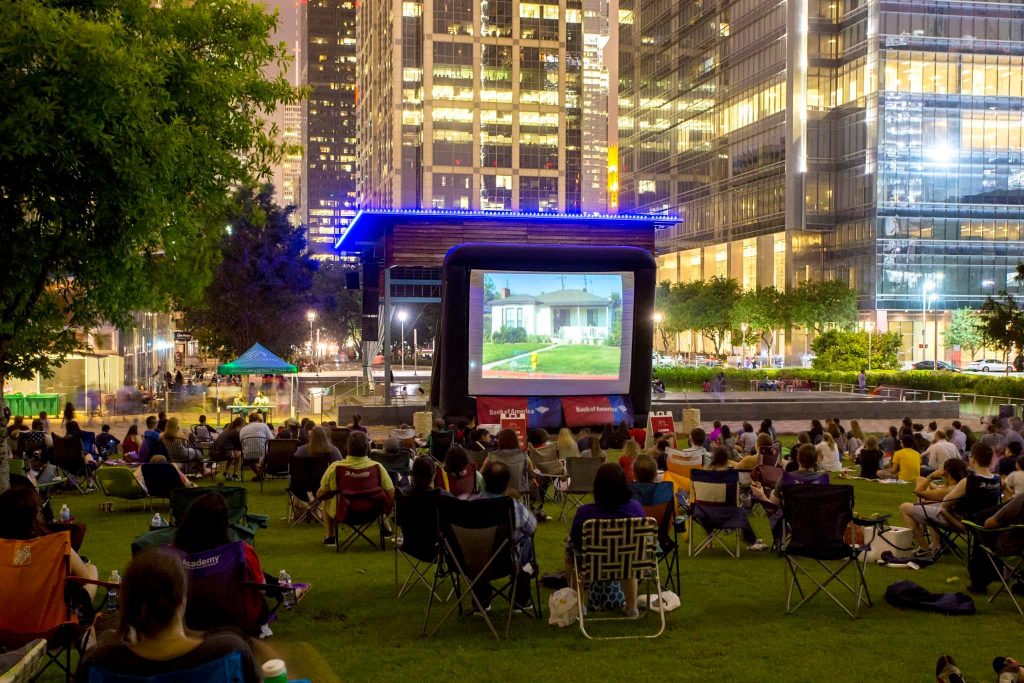
Discovery Green’s free movie night series, Bank of America’s Screen on the Green, returns May 27 and June 3. / Photo courtesy of @DiscoveryGreenHouston on Facebook 

“The role of president at Discovery Green encapsulates everything I ever dreamed of in my career,” Lott said in a statement.

“I look forward to caring for a beautiful and respected green space while fundraising for programming and performing and visual arts,” she continued. “I am eager to incorporate Houston’s technology into the landscape of the park and continue to make an impact in the community.”

Lott joins the Discovery Green Conservancy from her role as Executive Director of Southern Smoke Foundation, the Houston-based nonprofit that provides emergency relief funding and mental health services for food and beverage industry workers.

In addition, Lott has previously worked for Houston Grand Opera, Performing Arts Houston (formerly Society for the Performing Arts), and the Children’s Museum of Houston. She has also managed her own production company, Lott Entertainment, which she co-created in 2014.

Retiring President Barry Mandel, whose own pre-Discovery Green experience included leadership roles with the Houston Downtown Alliance and the Theater District Association, served as Lott’s mentor when both of them worked together in the downtown arts community, according to a press release.

“You do not know how much joy it gives me to turn over something I love to someone I love,” said Mandel in a statement. “I know she understands the essence of this place and how much it means to me, the team, and the community.”

Aris Kian Brown is named Houston’s Sixth Poet Laureate – and the youngest to be chosen

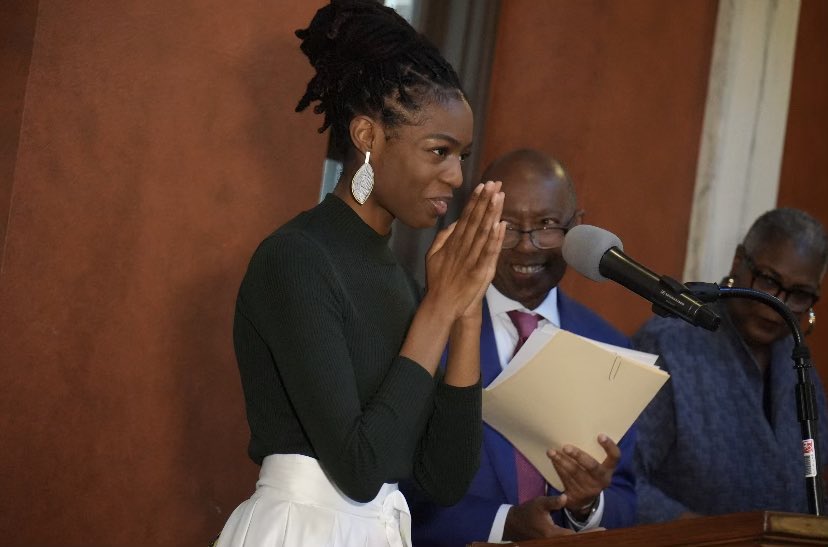
Aris Kian Brown and Houston Mayor Sylvester Turner / Photo by Houston Mayor’s Office

Poet Aris Kian Brown says that her loves are language, communication, and community organizing. In her new role as Houston Poet Laureate, she will aim to combine those passions to serve Houstonians through teaching, special projects, and written and spoken verse.

“Poetry is a powerful tool to imagine new worlds for ourselves, and I’m excited for the opportunity to continue building narrative power in this city,” she said.

Brown, 25, was officially named Houston’s sixth and youngest Poet Laureate in a reception last Thursday hosted by Mayor Sylvester Turner, the Mayor’s Office of Cultural Affairs, and Houston Public Library. She was selected through an application process by a committee of poets, scholars, literary experts, and community representatives, with final determination and appointment by the Mayor.

“It is an honor to have selected Aris as the next Poet Laureate,” said Mayor Turner in a statement. “She represents Houston’s literary future with her prophetic poetry. She will continue the Poet Laureates’ hard work before her, inspire the City of Houston with her words, and bring out the poetry in everyone.”

Houston Mayor Sylvester Turner and Aris Kian Brown / Photo by Houston Mayor’s Office

Brown’s two-year term begins this month, in celebration of National Poetry Month, and runs through April 2025.  She succeeds poet Emanuelee “Outspoken” Bean and continues the Houston Poet Laureate tradition, which was launched by Mayor Annise Parker in 2013 with Gwendolyn Zepeda as the city’s inaugural Poet Laureate.

Houston has one of the longest-running poet laureate programs among the five largest cities in the U.S. Los Angeles started its program in 2012, and Phoenix began appointing a Poet Laureate in 2016. Chicago will inaugurate a Poet Laureate this year, while New York does not have a Poet Laureate for the city as a whole – though four of its five boroughs have individual poet laureates, with the oldest program established in Brooklyn in 1979.  Houston’s Youth Poet Laureate program also continues to thrive, with poet Ariana Lee appointed as Brown’s teen counterpart last fall.

Ariana Lee, Houston Youth Poet Laureate, and Aris Kian Brown, Houston Poet Laureate / Photo courtesy of Ariana Lee

Brown received her MFA from the University of Houston’s Creative Writing Program. She won the 2022 Inprint Marion Barthelme Prize in Creative Writing for Students with Service to the Houston Literary Community, and recently earned the #2 rank at the 2023 Womxn of the World Poetry Slam. She also serves as the Narrative Change and Media Manager at Houston in Action.

Houston’s literary community reacted on social media with support and enthusiasm for Brown’s appointment – including local poets who expressed admiration for Brown’s writing.

“I love @rosewaterframes’s poetry! Congratulations on becoming the Houston poet laureate. Well deserved,” tweeted poet and translator Stalina Villarreal.

Poet Ayokunle Falomo wrote on social media: “Aris Kian Brown has been my (as well as the city’s) unofficial official poet laureate for so long. Glad it’s official official now! Lead us, Poet.”

Houston Arts Journal reached out to Brown for permission to print her poem, “Oh, Lola’s,” inspired by the Montrose neighborhood bar, Lola’s Depot:

Oh, Lola’s

You bumper sticker junkyard, jukebox bright,
blasting the pink-light anthem of a night

gone on too long. Slide my second sour ‘cross
the bar beneath the frilly B-cup bras

hanging like neon chandeliers. I’ll chug
down your year-round holiday at our snug

side table: string lights & sloped wooden bench,
still jacked from back-throat cackles. In moments

I think I missed out, I remember you,
backdrop to Polaroids snapped in the blue

hour with all the homies who held me well
after the flash. I ask too much of this hell-

swept city, and sometimes, beneath the ice
and maraschino cherries, it answers twice.

Aris Kian Brown

As Houston Poet Laureate, Brown will create and implement a Community Outreach Project. She will also receive a $20,000 honorarium through the City Initiative Grant Program of the City of Houston, which is funded through the Hotel Occupancy Tax that is dedicated to the arts.

Brown’s project, entitled Space for Us: Afrofuturism and the Poetic Imagination, will involve conducting interviews with Houstonians and then stitching a poem from their answers – to highlight the poetry “already embedded in everyday people,” according to a press release. The finished poem will be translated into the top spoken languages in the city.  

“My community outreach project seeks to connect with Houstonians in different neighborhoods and learn about their relationship with this city,” said Brown. “I aim to work with community organizations and language justice experts and translation artists to consider how this initiative can be accessible to the communities that speak the various languages of this city besides English.”

“I want to honor the global hub and dynamic that is the love of my life: Houston, while also staying true to my imagination, which is rooted in abolition and Afrofuturism,” she added.

Aris Kian Brown, 2023-2025 Houston Poet Laureate / Photo by Houston Public Library

Houston’s oldest poetry reading series, First Fridays, relaunches post-pandemic

First Fridays at Inprint, in a photo from Dec. 7, 2019 / Courtesy of First Fridays Facebook page

When poet Chris Wise moved to Houston about 20 years ago, he searched for open mics where he could perform his poetry.  That’s when he discovered First Fridays—and he’s a better writer for it, he says.

“What I liked about it was that it was free, which is a beautiful comment on who may participate. I was very broke back then,” said Wise. “The range of skill level and notoriety of the readers spanned the spectrum—so there really was a space for everyone. I became friends with the writers I admired, and in turn I learned from them.”

There have been other local poetry readings and open mics that he’s attended over the years, he added, but some are gone or now rebooted under different concepts by different people.

“First Fridays has been consistent and under one person, Robert Clark,” Wise said.

Robert Clark, founder of First Fridays, in a photo from January, 2020 / Courtesy of First Fridays Facebook page

Clark, a longtime Houston-based poet, educator, and director of the Houston Poetry Festival, established First Fridays in 1975. He coordinated and hosted it without interruption until March 2020 when it was indefinitely suspended because of the COVID-19 pandemic.

Determined to bring it out of its hiatus and to continue Clark’s vision, a group of 20 local poets and First Friday regulars organized and rallied this past winter, and came up with a plan to revive the series.

“[Robert] has been hoping that someone would pick up his love and passion for his First Friday Reading Series for him,” said Richard Gamez, Clark’s longtime partner. Clark has been struggling with health issues recently, leading loved ones to establish a GoFund Me campaign on his behalf.

First Fridays COVID-19 shutdown notice from 2020 / Courtesy of Chris Wise

First Fridays is now set to relaunch over the next 12 months at Inprint, resuming for the first time since the pandemic. Four local poets (Kelly Anne Ellis, Angelique Jamail, Yolanda Movsessian, and Chris Wise) will rotate as hosts. Each event is free and includes a reading by a featured poet, followed by an open mic for anyone to perform their work.

Wise shared with Houston Arts Journal the First Fridays 2023-2024 season schedule:

DATEHOSTFEATURED POET
April 7, 2023Chris WiseMarlon Lizama
May 5, 2023Kelly Anne EllisJohn Gorman
June 2, 2023Yolanda MovsessianAnthony Sutton
July 7, 2023Yolanda MovsessianRebecca Danelly
August 4, 2023Kelly Anne EllisTina Cardona
September 1, 2023Kelly Anne EllisMaha Abdel Wahab
October 6, 2023Yolanda MovsessianAyokunle Falomo
November 3, 2023Angelique JamailCharlie Scott
December 1, 2023Chris WiseAmir Safi
January 5, 2024Angelique JamailChrista Forster
February 2, 2024Angelique JamailPaige Poe
March 1, 2024Chris WiseBlacksnow

The inaugural post-pandemic reading is Friday, April 7, 2023 at 8pm at Inprint. Doors open at 7:30pm. Chris Wise hosts poet-activist Marlon Lizama, author of My Spanglish Hip Hop Story.

A piece of Houston’s literary history

During its 45 years, from 1975-2020, First Fridays grew into a series beloved by local poets.

“I always have a great time when I am able to go and look forward to getting to hear a variety of poets, those that I have known for years and new friends I’m meeting for the first time,” wrote Lupe Mendez, 2022-2023 Texas Poet Laureate, in an article for Poets & Writers.

Stories of its venue changes have taken on the quality of folklore, according to poet and original attendee R.T. Castleberry.

Castleberry recalls First Fridays’ early years, when the open mics and readings were held at locations like an auction house, the Orange Show, a café, and music clubs and bars—including Hard Thymes, a former folk music venue once located on Bissonnet.

“Hard Thymes was split between a bar area and a performance/eating area complete with an elevated stage. In the five or so years First Friday was held there, it became notorious for the rowdy behavior of both performers and audiences. As mentioned, it had a bar area,” said Castleberry.

After Hard Thymes closed, the series moved to the former Firehouse Gallery on Westheimer.

“The Firehouse featured a large, brick porch for performers and audiences to relax and visit on, a tiny kitchen area behind the performance area where the cool kids hung out drinking beer and double glass doors in the street level performance area,” recalled Castleberry.

“In the days when the Westheimer Weekend Crawl was in its heyday, the poets read with their backs to the street—and the street traffic. The Firehouse also continued in the First Friday reputation for unruliness,” he said.

Scenes from First Fridays at Inprint / Courtesy of First Fridays Facebook page

First Fridays eventually settled down its roots at Inprint, which has provided a home for the series for the past 20-plus years.

“[Robert Clark] wanted there to be a space for local poets to share their work with the public and each other. He was committed to always highlighting a featured writer, followed by an open mic, so that less established writers could share a poem or two,” said Krupa Parikh, Inprint’s Associate Director.

Parikh says that some of the memorable and distinguished local poets, who have performed on the series over the years, include current and former Houston Poet Laureates Emanuelee “Outspoken” Bean, Robin Davidson, Deborah D.E.E.P Mouton, Leslie Contreras Schwartz, and others.

“Our former Houston Mayor Annise Parker was once an open mic poet,” Parikh added.

Legacy as Houston’s “oldest”

First Fridays has often been called Houston’s “oldest poetry reading series”—a distinction based on a general consensus among local poets.

Houston Arts Journal also reviewed the timeline of several local reading series. Inprint’s own Margarett Root Brown Reading Series, now in its 42nd season, is a close second oldest (and features both poetry and fiction). In addition, Houston has plenty of other well-established literary series that have formed in the past two-to-three decades and in recent years, including Gulf Coast, Nuestra Palabra, Poison Pen, Public Poetry, Write About Now, and Tintero Projects. Together, they provide an overlapping network of poets, writers, and lovers of the written and spoken word, forming the fabric of the city’s literary scene.

Parikh believes that First Fridays has had a “tremendous impact” on the local poetry community.

“It has given established and emerging poets a platform to share their work and helped many local poets connect with each other. It has also helped encourage many to keep writing poetry and keep nurturing a love of it,” she said.

Poet Chris Wise / Courtesy of chris-wise.com

Poet Chris Wise also notes that the series’ supportive and welcoming atmosphere creates a space not only to enjoy poetry—but to learn, collaborate, receive feedback, and share opportunities on a more level playing field.

“The collection of word artists who come to First Fridays range from unpublished to widely published,” he said. “First Fridays has always bridged the gap between street poets and academic poets, between the beats and the elites.”

Parikh says that part of what makes First Fridays unique is “a very community-based feel, thanks to the way Robert ran it”—a spirit that organizers have aimed to recreate in their grassroots efforts behind First Fridays’ relaunch, keeping it independent from any institution.

“While Inprint is proud to be host of the series and provide support, the curation, logistical planning, and organizing of First Fridays today is led by community members,” said Parikh. “We are thrilled to see the way these community members are coming together to reignite the series and carry on Robert’s legacy.”

Houston poets are recognized by the Texas Institute of Letters 2023 Literary Awards

Jasminne Mendez, winner of the Texas Institute of Letters’ 2023 Helen C. Smith Memorial Award for Best Book of Poetry / Courtesy of JasminneMendez.com

The Texas Institute of Letters recently announced the winners of its annual Literary Awards – writers whose works represent “the best of Texas literature,” as described by the organization’s president Diana López.

“Each year, the TIL recognizes the best of Texas writing in a variety of genres that includes fiction, poetry, nonfiction, scholarly writing, design, and short form works. Many thanks to our judges for carefully considering the entries,” said López in a statement. “This year’s winners demonstrate the wonderful talent and diversity of writers with Texas roots.”

Eligibility for the 2023 awards required that “the author was born in Texas or has lived in Texas for at least five consecutive years at some time. A work with subject matter that substantially concerns Texas is also eligible,” according to online guidelines. The work must have been published in 2022.

Winners will collectively receive more than $27,000 in prizes, to be presented at the Texas Institute of Letters Awards Ceremony in Corpus Christi on April 29, 2023.

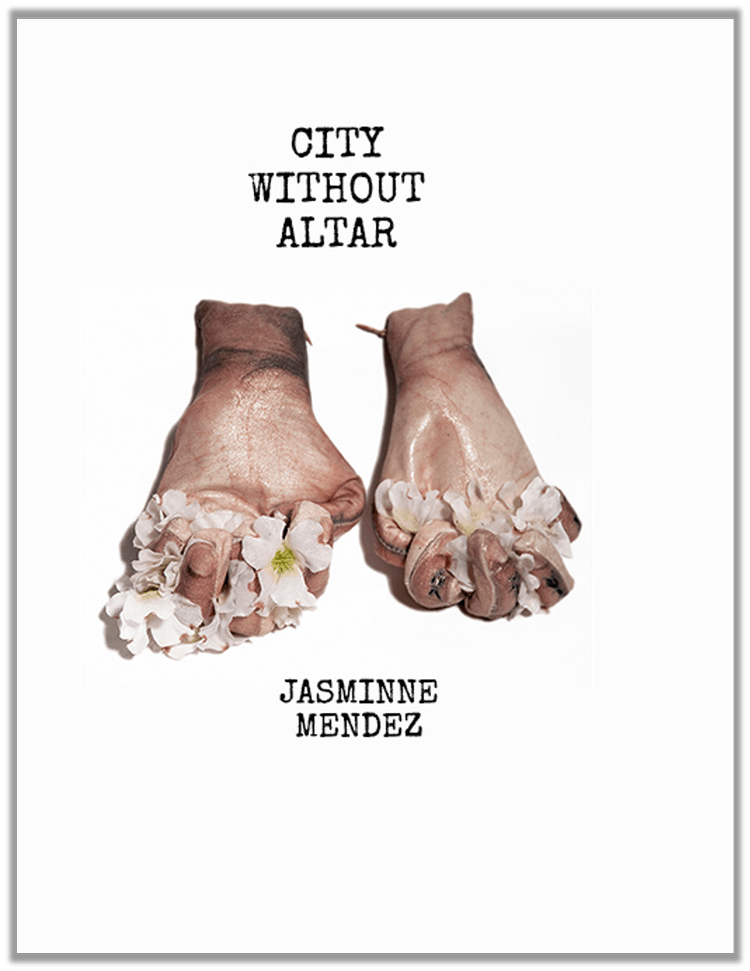
Jasminne Mendez, a multigenre writer and translator based in Houston, is the winner of the 2023 TIL Award for Best Book of Poetry for City Without Altar (Noemi Press).

City Without Altar is a poetry collection and play in verse that explores what it means to live, love, heal and experience violence as a Black person in the world. The titular play in verse that sits at the center of the book seeks to amplify the voices and experiences of victims, survivors and living ancestors of the 1937 Haitian Massacre that occurred along the northwest Dominican/Haitian border during the Trujillo Era. Between the scenes of the play are “interludes” that explore a different kind of “cutting” and what it means to feel othered because of illness, disability and blackness.

Noemi Press
Courtesy of Noemi Press

Mendez was also named a finalist for the 2023 TIL Best Young Adult Book Award for Islands Apart: Becoming Dominican American (Piñata Books), a memoir of her coming-of-age experiences in the United States as an Afro-Latina. A winner of Arte Público Press’ 2021 Salinas de Alba Award for her debut children’s book Josefina’s Habichuelas (Arte Público Press), Mendez also recently published her first middle grade novel in verse, Aniana del Mar Jumps In, released on March 14, 2023.

Acclaimed Houston poet Ayokunle Falomo was recognized as a finalist in the 2023 TIL Best Book of Poetry category for his collection, AfricanAmeriCan’t (Flowersong Press).

Ayokunle Falomo, finalist in the 2023 TIL Literary Awards

“In AfricanAmeriCan’t, Falomo tenderly traces his body on the American political map. The exciting inventiveness of language wills Diasporic histories into poetic form,” said poet and filmmaker Loyce Gayo, in a statement on the book. “This feat of a project gives those of us tussling with the many failures of nation permission to own and fully embrace a boundless grief, a righteous rage, and bountiful stillness.”

A recipient of fellowships from Vermont Studio Center, MacDowell, and the University of Michigan’s Helen Zell Writers’ Program, Falomo has been anthologized and published by Houston Public Media, Michigan Quarterly Review, The Texas Review, New England Review, Write About Now, and others.

Houston writer J. Estanislao Lopez was named a finalist in the 2023 TIL Award for First Book of Poetry for We Borrowed Gentleness (J. Alice James Books) – praised as a “compelling debut collection” that contains an “unsentimental directness,” in a review by David Woo.

J. Estanislao Lopez, finalist in the 2023 TIL Literary Awards

“[Lopez] knows that words, however meager, help to counter life’s irremediable violence,” wrote Woo in his review. “For Lopez, the details begin in Texas, with a father who crossed the river from Nuevo Laredo …”

Lopez’s poetry has been published in The New Yorker, Ploughshares, The Rumpus, and Poetry Magazine, and he earned an MFA from Warren Wilson Program for Writers.

Founded in 1936, the Texas Institute of Letters is a nonprofit honor society that aims to celebrate Texas writers, as well as literary works with ties to the Lone Star State. According to a press release, its elected members include Texas-based writers who have won the Pulitzer Prize, National Book Award, PEN/Faulkner Award, Man Booker Prize, Academy Award, International Latino Book Award, Americas Award, Lambda Literary Award, MacArthur Fellowship, and Guggenheim Fellowship.

TIL’s long history of supporting and honoring Texas literature through various author awards can be traced to 1939, as archived on its website.

A complete list of 2023 TIL Literary Award winners can be found here.

ROCO launches its 1st musical children’s book, part of continued efforts to increase access to classical music

Courtesy of ROCO

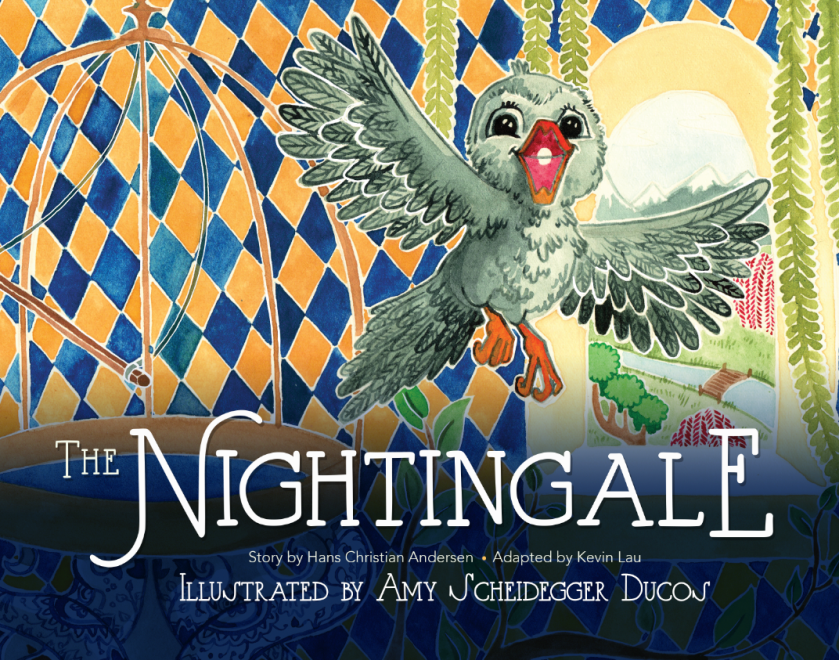
Inspired by a Hans Christian Andersen fairy tale set in China, The Nightingale by Kevin Lau is a piece that Alecia Lawyer, ROCO Founder and Artistic Director, calls “seriously Peter and the Wolf worthy.”

ROCO commissioned Lau’s trio for violin, clarinet, and piano and debuted it in 2018, along with commissioned illustrations by artist Amy Scheidegger Ducos, which were projected during the World Premiere performances.

“It was such a good piece that we performed it multiple times, and I realized that it could be an amazing children’s book,” said Lawyer.

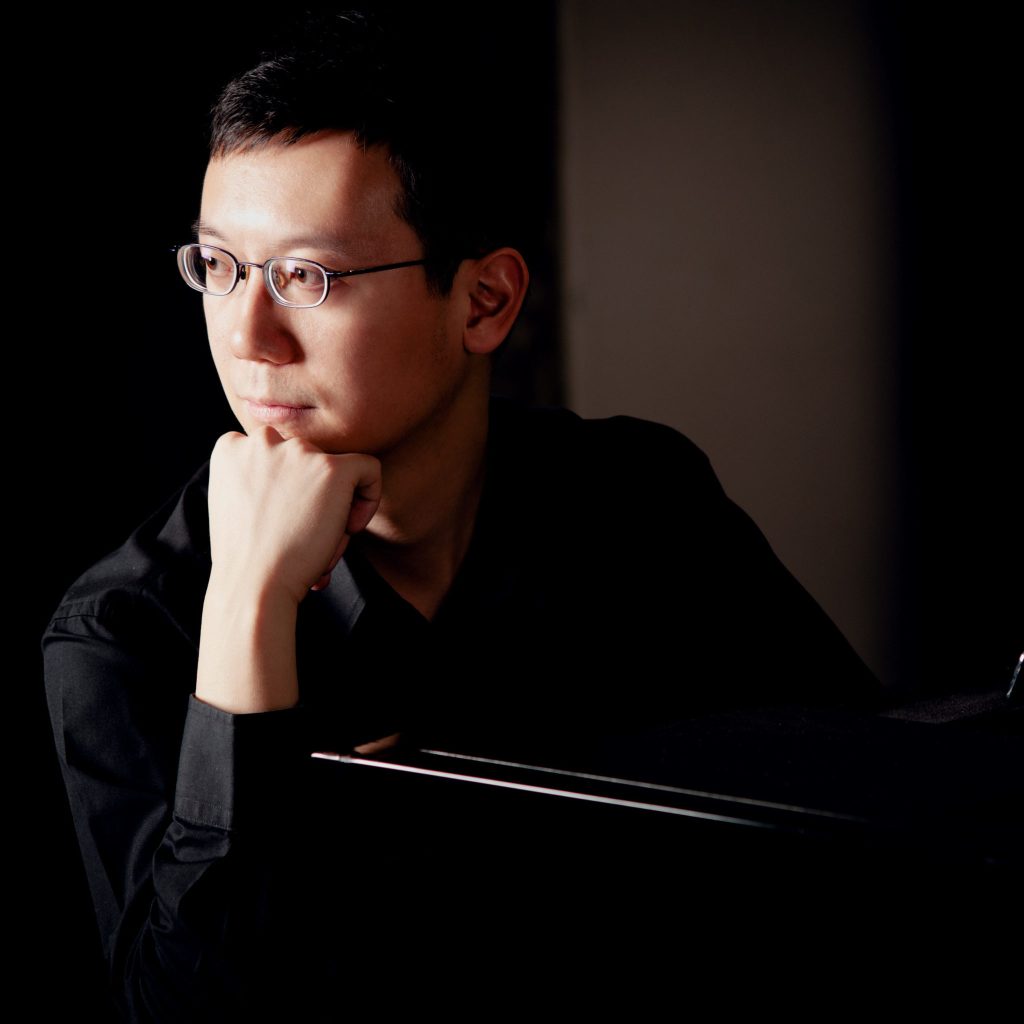
Composer Kevin Lau / Courtesy of ROCO

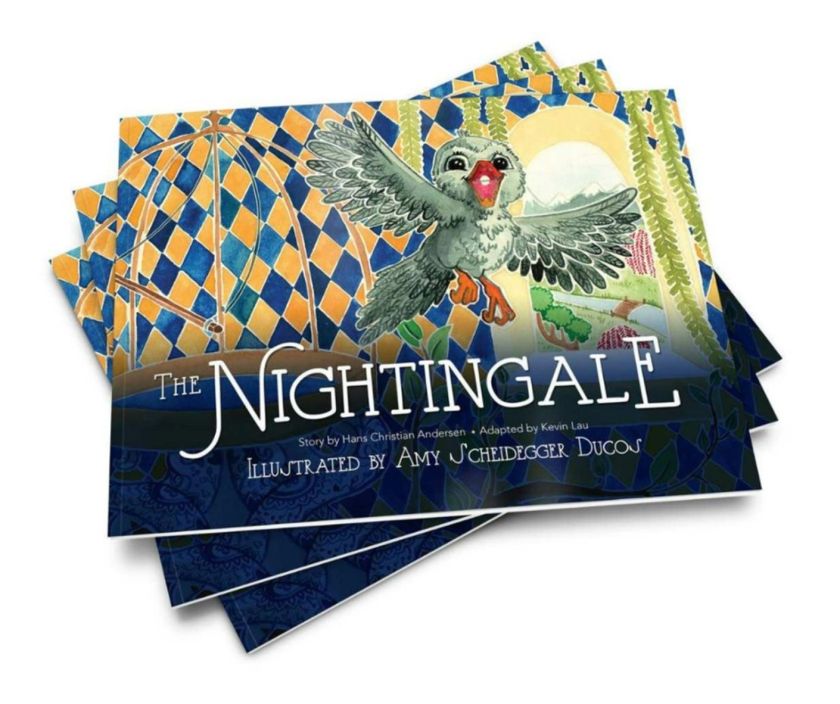
That idea was realized when The Nightingale was released this past December as an interactive, multi-media storybook, featuring music and adapted text by Lau, illustrations by Ducos, and narration by Emmy Award-winning Houston journalist Miya Shay. ROCO will officially launch and celebrate the book with a free performance on Saturday, April 1, 2023, 10:30am at Houston Public Library.

While Lawyer says that ROCO did not initially set out to create a children’s book, Lau’s piece naturally aligned with the organization’s passion for fostering collaboration and access to classical musical.

“All of our art is purposeful but based upon relationships,” Lawyer said, alluding to the personal collaboration between Lau and concertmaster Scott St. John, whose love of Disney led to the fairy tale-inspired commission.

“Our number one value is access,” she added. “We love multi-generational audiences. What better way to encourage this than a children’s book?”

In its book format, The Nightingale combines music, art, literacy, and technology through the use of QR codes that allow readers to choose-their-own reading experience. Through three different QR codes, adults and children can listen to narration and music, music with page-turn prompts, or music only, while reading.

ABC13 news reporter Miya Shay / Courtesy of Twitter

ROCO has long-utilized and experimented with technology in an effort to increase accessibility to concerts and recordings of classical music.

Well before the COVID-19 pandemic’s lockdowns, which led many arts groups to develop virtual performances, ROCO had already begun live streaming orchestral concerts on its website in 2013, expanding to Facebook in 2018. It continues to live stream performances, and to archive audio for on-demand listening, on multiple platforms.

Other initiatives to increase classical music access have included the ROCO App, launched in 2018, and ROCO on the Go, pioneered in 2020 with Buffalo Bayou Park “as a response to the pandemic and reaching audiences who were spending more time outside,” according to Amy Gibbs, ROCO’s Managing Director.

The only music project of its kind in the city, ROCO on the Go has curated playlists for numerous Houston landmarks – essentially creating a site-specific soundtrack, accessed by using a smart phone to scan a QR code at that location. Its most recent QR code was placed at James Driver Park in Harris County Precinct 2 and was created in collaboration with Spectrum Fusion, which serves neurodiverse adults.

“Their members curated a playlist of their own favorite pieces from ROCO’s library for the fully inclusive park, which is designed to meet the needs of visitors with disabilities,” said Gibbs.

Courtesy of ROCO

The release of ROCO’s first children’s book, The Nightingale, is a continuation of such efforts to take classical music outside the concert hall and to offer listeners multiple entry points for enjoyment.

When asked if ROCO hopes to publish more music-inspired children’s books or a book series, Lawyer says there are no definite plans at the moment.

“I am always open to new music and new ways to connect young and young at heart,” she said. “I won’t say ‘no,’ but it isn’t necessary to make it a new endeavor.”

Instead, she says that ROCO aims to continue to engage the community through both book and musical versions of The Nightingale. The ensemble will premiere a new arrangement of the piece for chamber orchestra in a free concert at Miller Outdoor Theatre on September 29, as well as turn it into a coloring book – an idea from a Kinder HSPVA student, said Lawyer. ROCO has also added Braille to the book’s pages, with plans to bring that edition for visually impaired readers to The Lighthouse of Houston in coming weeks.

At the book’s April 1st launch at Houston Public Library, the first 50 children in attendance will receive free copies, and ROCO says it will donate copies to library branches citywide and to the Barbara Bush Houston Literary Foundation.

“Let’s dig deeper and not bigger with this one as a through line to as many communities as we can,” said Lawyer.

Houston Youth Poet Laureate Ariana Lee’s new poem responds to the Monterey Park shooting

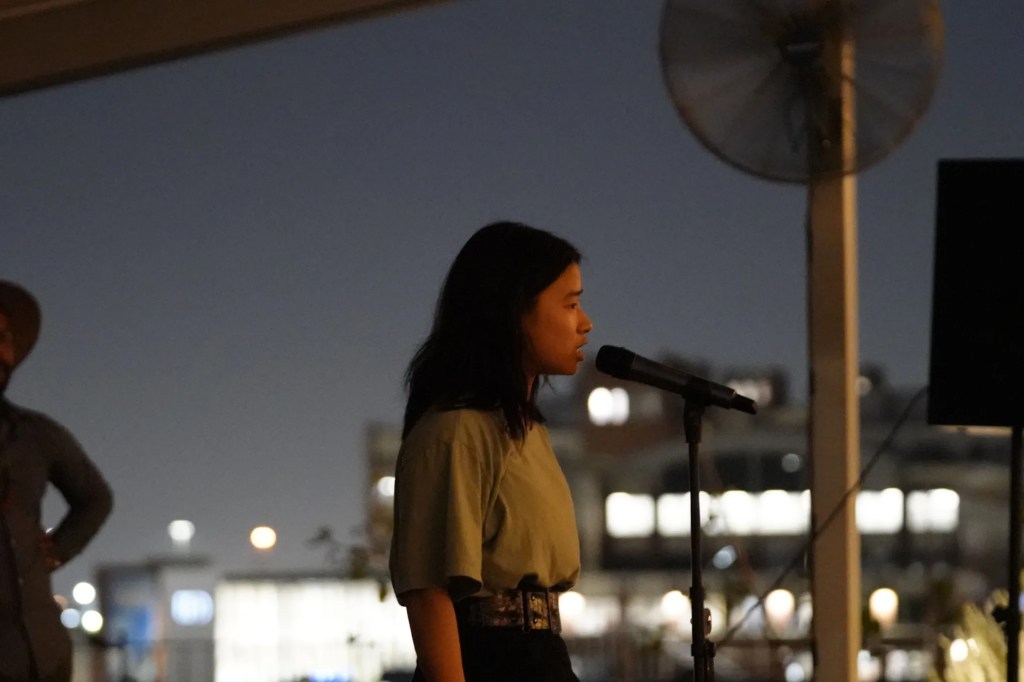
Ariana Lee, 2022-2023 Houston Youth Poet Laureate / Courtesy of Ariana Lee

When Ariana Lee heard about the recent mass shooting in Monterey Park, California, she said she felt deeply saddened and wanted to write a poem to help process her thoughts.

On January 21, a gunman killed 11 people as they rang in the Lunar New Year at the Star Ballroom Dance Studio, before he was later disarmed by a 26-year old man named Brandon Tsay, who prevented the gunman from carrying out a second nearby attack.

“A large memorial is seen outside the Star Dance Studio in Monterey Park, Calif., about a week after a mass shooting at the ballroom studio killed 11 people and wounded 10 others.” / Credit: Jane Hahn for NPR

Lee, a high school senior at St. John’s School, was appointed the 2022-2023 Houston Youth Poet Laureate last November. And now, only a few months into her term, she found herself writing an elegy about a mass shooting – one that felt especially personal because of its intersection with two holidays: Lunar New Year and her 18th birthday.

Remembering that her predecessor Avalon Hogans had written a poem after the Uvalde tragedy for March for Our Lives Houston, Lee decided to contact that organization to offer to write a poem, to be shared in collaboration on social media. The result was “Morning, America,” written in response to the Monterey Park shooting. 

Watch Ariana Lee perform her poem below.  Houston Arts Journal also reached out to Lee for an interview and permission to reprint her poem, which follows.

Morning, America

Today, I am eighteen years old.

At age seventeen,
yesterday, and the day
before, and the day
before, I woke up
to mourning.

I woke up to mourn
what was before me.

When there have been more mass shootings
in the year than there have been days,
and when there are more guns
in the US than there are people,
you wonder if eighteen—the legal age
to buy a gun—is worth celebrating.

Lunar New Year always occurs
around my birthday. We wear red
for good luck and eat
long noodles for longevity.
Put your hands together like a prayer—
新年快乐,身体健康,恭喜发财,吉祥如意.

But now we pray. You would think
the gun industry had joined us
in our spring cleaning, the way our deaths
are so easily swept under the rug. We set off
firecrackers to ward off evil, but I hear
gunshots. Maybe if I wear enough red,
bullets will stop wearing holes in our communities.

My culture is my inheritance, and the biggest
evil is how inherent gun violence has become to our culture.

We’ve crossed into the Year of the Rabbit.
I think we’ve had enough time to learn
this lesson: Look from one end
of the barrel, and it’s easy to see prey.

It should not be this easy to turn
sacred into scared. We wish: 新年快乐,
但是我们的乐真的很快.
Can our happiness only
be fleeting? And fleeing,
our best method to avoid death?

It’s been eighteen years
since my birth. I’ve celebrated
eighteen Lunar New Years.

This holiday means sleeping with a 红包
under my pillow for fifteen days. It means waking.
I wake up. Wake up—it’s beyond time
to make a good morning.

Ariana Lee

How did this poem come to you? What were you feeling or thinking when you sat down to write it? Would you like to say a little about your writing process?

When I know what I want to say, I tend to write poems pretty quickly. This poem came from letting my emotions guide my writing. I was inspired by characteristics of Lunar New Year such as the color red, spring cleaning, and the 红包 (red envelope). 

How did you learn of the shooting and how did it affect you?  The poem seems to imply that it was on your birthday, as well as Lunar New Year – is that right? If so, how did the fact that it happened on or around those holidays affect you?

I learned a lot about the shooting in part because I serve as a co-president of my school’s East Asian Affinity Group and on the leadership board of our Unity Council. We extensively researched it for a joint forum to inform students and give them time and space to process what had happened. 

In my personal life, Monterey Park struck a chord because of how culturally important Lunar New Year is to my family. It should be a time of celebration. The holiday occurs on a different day every year because it follows the lunar calendar, but it typically occurs a few days before or after my birthday (January 25th). One year it was even the same day. Growing up, I saw Lunar New Year and my birthday as a package deal. This year, they were marked by tragedy—a preventable one. Learning about Monterey Park has motivated me to be active in gun violence prevention.

In your social media post, you wrote: “Thinking of Fort Pierce, Baton Rouge, Half Moon Bay, and Des Moines. Thinking of all the poets who’ve written this poem before. Thinking of my grandparents.”  Can you say more about what you mean by that?   And, in particular, can you tell me a little about your grandparents, and how you were thinking of them?

After Monterey Park, mass shootings occurred in Baton Rouge and Half Moon Bay. There have also been shootings in Fort Pierce and Des Moines. So many in such a short time. I wanted to acknowledge that, even though my poem was written in response to Monterey Park, it’s really for each community affected by gun violence. 

The second sentence refers to the fact that many brilliant poets before me have written poems in response to senseless, unnecessary violence. Specific poems that inspired me are “not an elegy for Mike Brown” by Danez Smith and “what the dead know by heart” by Donte Collins

The victims of the Monterey Park shooting are around the same age as my grandparents. When I read about them—Xiujuan Yu, Hongying Jian, Lilian Li, Wen Yu, My Nhan, Muoi Ung, Valentino Alvero, Diana Tom, Yu Kao, Ming Wei Ma, Chia Yau—I couldn’t help but see my Laolao and Yeye in them. 

What do you believe is the role of poetry (or art, in general) in times of crisis or profound loss?

For me, art is healing and inspiration. Art can connect with people in a way that the plain, straight facts can’t. When crises challenge society, I believe poetry’s role is to bring people together and give them words to meditate over when they are at a loss of words themselves. 

***

Translations for “Morning, America”:
新年快乐 = Happy New Year
身体健康 = Wishing you good health
恭喜发财 = Wishing you prosperity
吉祥如意 = Wishing you good luck
但是我们的乐真的很快 = but our happiness really is fleeting
红包 = red envelope