
New mural will honor Macario Garcia, local Latino war hero

Rendering of mural by artist Mez Deta / courtesy of UP Art Studio

After three years of planning and community advocacy, painting begins today on a mural in tribute to Staff Sergeant Macario Garcia – to share with new generations the story of the first Mexican immigrant to receive the Medal of Honor, the United States’ highest military award.

Born in Villa de Castaños, Mexico, Garcia immigrated with his family to Texas in 1923. Settling in Sugar Land, he and his parents worked as cotton farmers.

When World War II broke out, Garcia joined the US Army in 1942. His acts of bravery during the Allied invasion of Normandy and during combat against German troops as an acting squad leader in his platoon led to his receiving the Purple Heart, the Bronze Star, and the Combat Infantryman’s Badge, as well as the medal of Mérito Militar (the Mexican equivalent to the Medal of Honor). President Harry S. Truman awarded Garcia the Medal of Honor at the White House in 1945.

Artist Mez Data, known for his realistic portraits with aerosol paint, will create the mural on the exterior of Houston Fire Department Station #20 in East End’s Magnolia Park (6902 Navigation Blvd. at Macario Garcia Dr.). Luis C. Gonzales, a local veteran of the neighborhood, will assist the artist.

A project of UP Art Studio, known for its Mini Murals and other public art projects, the Macario Garcia mural will be unveiled in a ceremony on Veteran’s Day, November 11, 3 – 4:30pm.

The mural is a proposed gift to the City of Houston and will become part of its Civic Art Collection, upon official acceptance by Houston City Council.

Houston’s first Barbara Jordan sculpture is coming in 2022

Artists’ rendering courtesy of the City of Houston Mayor’s Office of Cultural Affairs

About two years ago, in August 2019, the Houston Mayor’s Office of Cultural Affairs began soliciting proposals from artists to create the city’s first permanent public art installation honoring the late, pioneering Texas politician Barbara Jordan – a native Houstonian, who became the first African American woman elected to the Texas Senate since 1883 and the first Southern African American woman elected to Congress.

This week, that project reached its next step: the announcement of a commission.

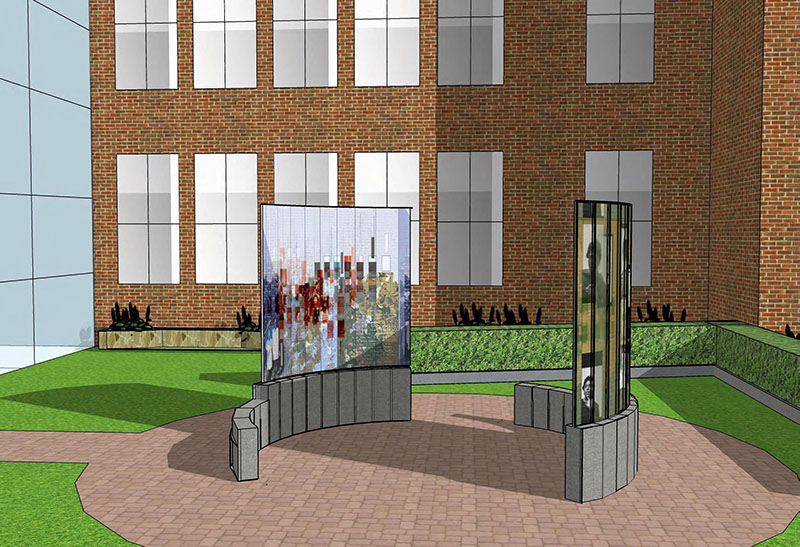
Houston artists Jamal Cyrus and Charisse Weston have been selected as the collaborative team to create the work, Meditative Space in Reflection of the Life and Work of the late Barbara Jordan.

Their concept features a sculpture of free-standing glass panels that will utilize photographic and text-based collages to highlight Congresswoman Jordan’s life as a politician, lawyer and professor – and also to celebrate her compassion, conviction and connection to family and community.

Artists’ rendering courtesy of the City of Houston Mayor’s Office of Cultural Affairs

Visitors can enter the space to reflect on the Congresswoman’s dedication to public service and racial justice. The design is informed by the Adinkra symbol sepow, which represents justice and authority.

Set to debut in the summer of 2022, the artwork will be installed at the historic African American Library at the Gregory School, a branch of Houston Public Library, at 1300 Victor Street in Freedmen’s Town.

It will be only the second outdoor sculpture or monument honoring a woman in the city’s Civic Art Collection – the other is “Peggy,” a statue by John Gutzon Borglum, in tribute to Elizabeth Stevens MacGregor in MacGregor Park – and the first honoring an African American woman.

“This commission marks a pivotal moment in the timeline of our Civic Art Program,” said Necole Irvin, Director of the Mayor’s Office of Cultural Affairs, in a press release.

“Commissioned at the special request of our Mayor [Sylvester Turner], this artwork firmly demonstrates the City’s commitment to broadening those perspectives represented by the artworks in our collection and our commitment to recognizing the diversity of heroes Houston enjoys,” she said.

Statues of Barbara Jordan have also been installed in Texas at the Austin-Bergstrom International Airport (2002) and at the University of Texas at Austin (2009), where Jordan taught.